

Stake games
Stake OriginalBlackjack: how to read the strategy chart
Hit, stand, double or split? Match your hand against the dealer’s card in our Blackjack strategy chart.
By The Gambling Desk · Published · Verified
A 16 against the dealer’s 10, an Ace with a 7, a pair of 8s: two blackjack hands with the same total do not always call for the same move. Find your hand in the chart, cross it with the dealer’s upcard and spot your next action.
Around the Blackjack table
You receive two cards, as does the dealer, whose first card remains visible. The aim: finish closer to 21 than the dealer without going over. Face cards count as 10; an Ace counts as 1 or 11 depending on the hand. An Ace and a ten-value card as your first two cards make a natural blackjack.
The Stake Original Blackjack page lists 3:2 for a natural blackjack and 1:1 for an ordinary win. Hit, stand and double are the basic actions. To separate a pair, the Split button must be available at your table: Stake’s public page mentions it, but check the controls in the version you are using.
Inside the Stake interface
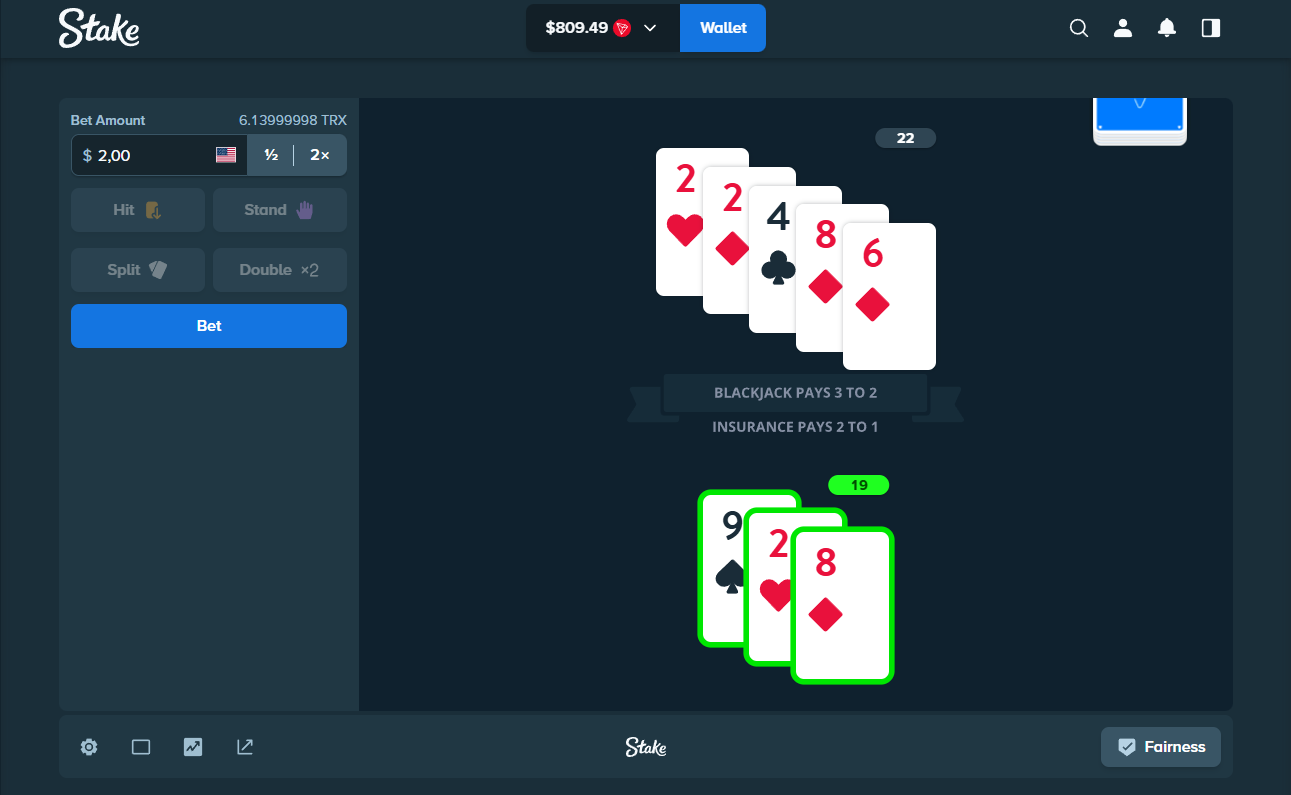
Stake Original Blackjack in pictures

The Blackjack strategy chart
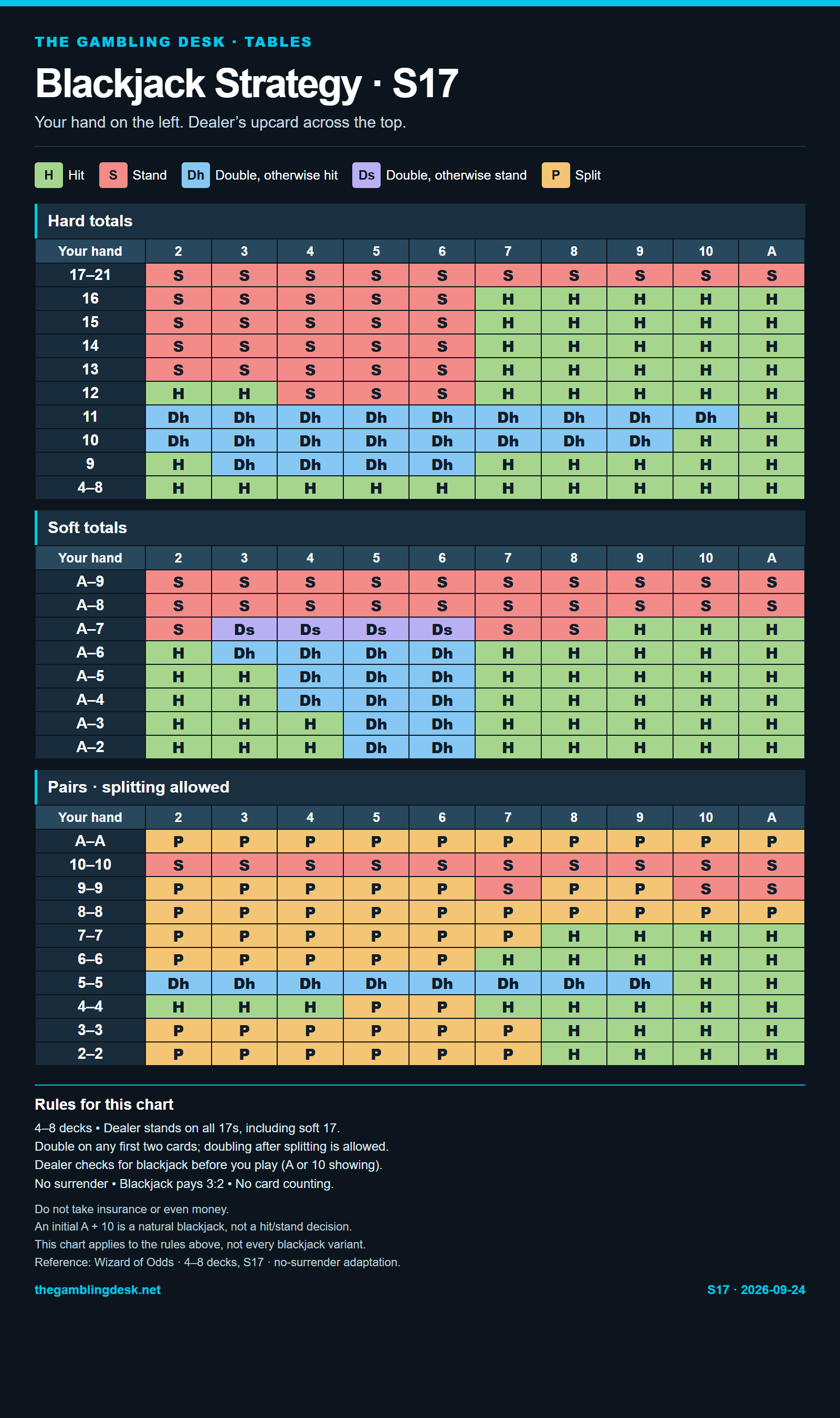
Start with your hand on the left, then move to the column for the dealer’s upcard. The grid separates hard hands, soft hands and pairs. The dealer’s 10 also represents a jack, queen or king.
This chart uses these rules: 4 to 8 decks, dealer stands on all 17s (S17, including Ace–6), doubling allowed on the first two cards and after splitting, and no surrender. It assumes the dealer checks for blackjack before your decisions when showing an Ace or 10. A natural blackjack pays 3:2.
At a live table, find these rules in the table information. According to its provably fair documentation, Blackjack Original uses an unlimited number of virtual decks, so this multi-deck chart does not validate every one of its rules. The name “Blackjack” and the S17 rule alone do not make all variants identical.
Hit, Stand, Double, Split: the key
- H — Hit: take another card.
- S — Stand: keep your hand.
- Dh — Double / Hit: double; if unavailable, hit.
- Ds — Double / Stand: double; if unavailable, stand.
- P — Split: separate the pair into two hands with a second bet.
Double cells apply to hands where that action is allowed. With three or more cards, use the fallback action shown by h or s.
This strategy does not recommend insurance, even with a natural blackjack. It is a separate bet on the dealer having blackjack; taking “even money” is equivalent to accepting that insurance. Ace–10 is therefore not listed among hands to hit or double.
Three hands to get your eye in
With 10 against the dealer’s 9, Dh means double if your hand allows it, otherwise hit. The same applies to 11 against 10.
With Ace–7 against a 2, stand: this is soft 18, found in the soft-hand section. Against 3, 4, 5 or 6, Ds means double if possible, otherwise stand.
With 8–8, start in the pairs section if splitting is allowed. If your version does not offer it, read the hard total 16: stand against 2–6, hit against 7–Ace, under the rules above.
If your version does not offer splitting
The P cells do not apply. For a pair without Aces, use its total in the hard-hand section: 7–7 becomes 14, 8–8 becomes 16. Ace–Ace is a special case: if you can continue playing the hand but cannot split it, hit; against a 6, double if allowed, otherwise hit, still under the stated S17 rules.
Keep the chart handy
Open the full-size image to read the cells, or find it alongside the other five games in the Stake Originals tables. The key and rules are printed in English on the image shared across all languages, so they stay with you when you download it.
Basic strategy aims for the best mathematical decision under the selected rules. It does not predict the next card or guarantee a round’s outcome. To check a completed deal, provably fair answers a different question: how the result was calculated.
Frequently asked questions
What is a soft hand?
A hand with an Ace still counted as 11. Ace–6 is soft 17; it can take certain cards without exceeding 21 because the Ace can change value.
Can I use the chart for any blackjack game?
No: the rules must match the chart. A dealer hitting soft 17, no prior blackjack check or restrictions on doubling can change the decisions.